
Gather Evidence
Shadowing

When to use it
By living like the user and observing them up close and in their environment, we can understand their behavior and find revealing insights into what they really value. Use this tool to gain deeper insight into actual behavior and emotions by observing a user going about their typical day or performing specific tasks relevant to your challenge
What’s the purpose
Also known as a “day in life study”, shadowing allows us to gather more nuanced observations about how a user behaves in an ordinary situation. By living like the user and observing a them up close and in their own environment, we can gain an in-depth understanding of their behavior and find revealing insights in their ordinary activity.
How to do it
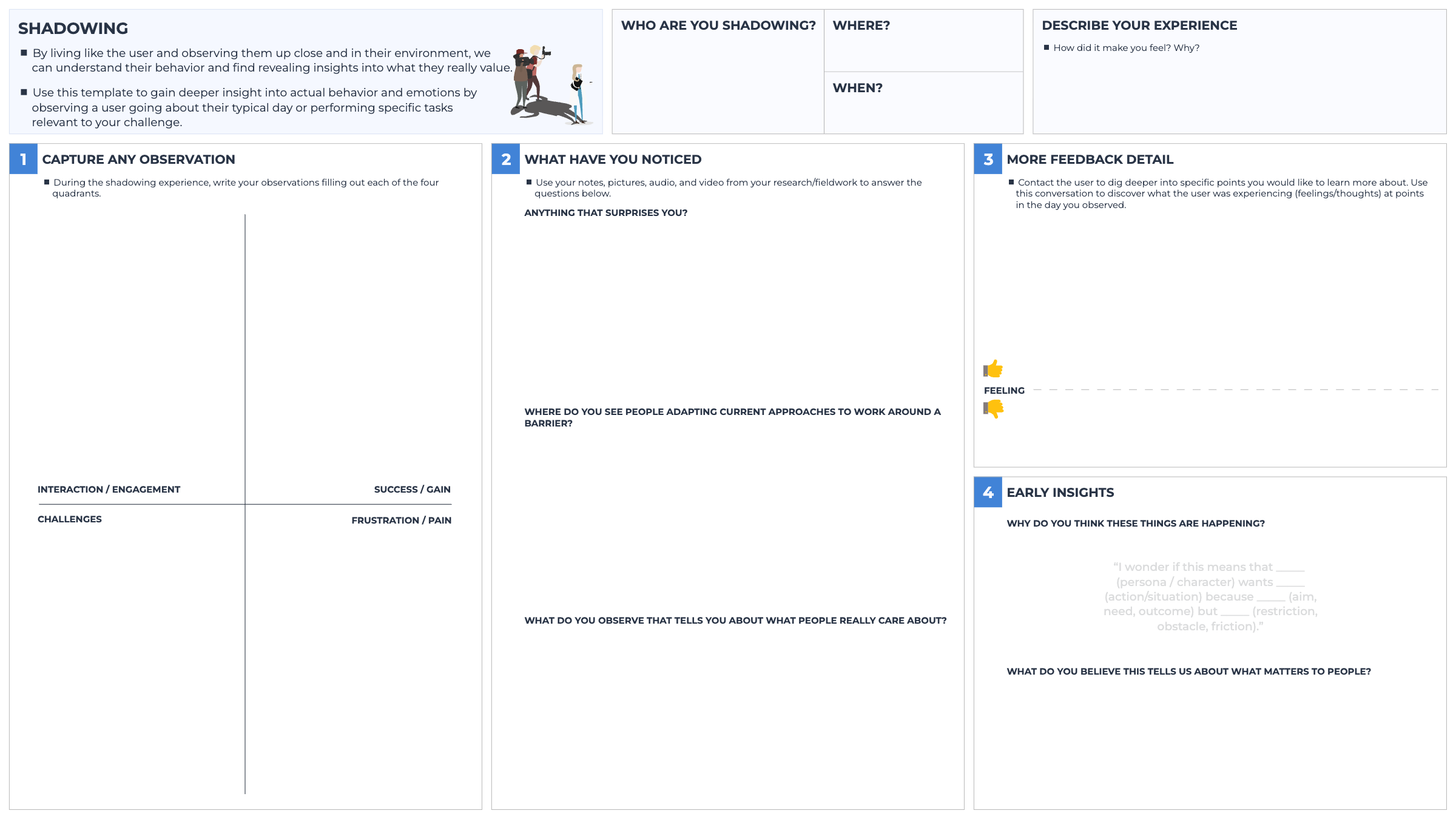
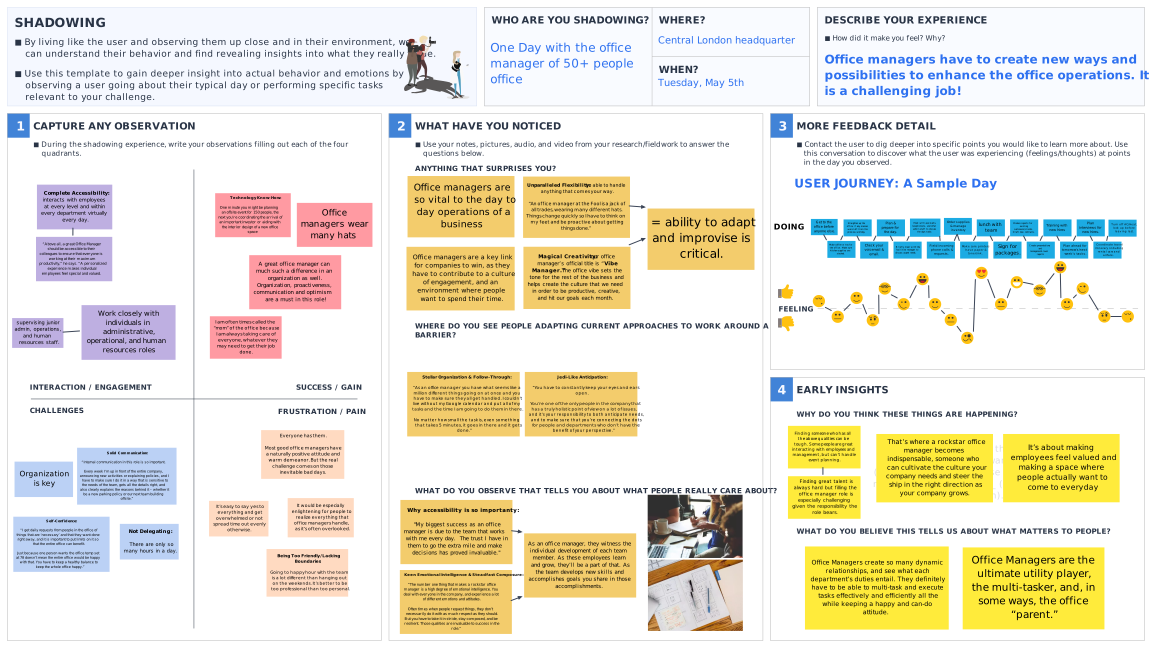
- Begin by noting down who you are shadowing, where it’s taking place and when.
- During the shadowing experience, capture your observations in the relevant quadrant in the space provided in step one. You can add photos and graphics to support your observations.
- Using your observations and any other supporting research findings, document the following:
- Anything that surprises you during the experience Where you notice people adapting current approaches to work around a barrier Things you observe that provide evidence for what people really care about
- At this point, it’s useful to get in touch with the user to dig deeper on specific points that you’d like to find out more about. Use this conversation to find out what the user was experiencing (feelings/thoughts) at specific points in the day that you observed. Make notes and plot the feedback on the feeling line in step three.
- Finally, form some early insights using the madlib below and note down what you think these insights tell you about what really matters to people.
- “I wonder if this means that _____ (persona/character) wants _____ (action/situation) because _____ (aim/need/outcome) but _____ (restriction/obstacle/friction)."
Tips
- Step into the user’s shoes and think about how it would feel if you were being shadowed. Keep this in mind as you go about the activity.
- You can use the ‘Forming Insights’ template to provide further guidance for crafting meaningful insights.
In day-to-day work
When you’re next looking to gain a deeper understanding of a particular situation in your day-to-day work, try to find an opportunity to shadow someone that will give you a window into their reality. Ask the person if they would allow you to “sit with them” for a day to understand what it feels like to be them.
For example, maybe you want to improve the company meeting culture. Think of some extreme users, like execs who have limited time and new employees who may feel out of their depth and are not used to the company’s ways of working. Shadow each of these groups to understand their nuanced experiences and reveal insights that can help you generate novel ideas.